What Is Query Fan-Out? How AI Search Works and Insights From 60,000 Queries
Query fan-out is how ChatGPT and Google AI Mode turn one prompt into many parallel searches. Learn how it works, plus insights from 60,000+ analyzed queries.
Query fan-out is how AI search engines like Google's AI Mode, ChatGPT, and Gemini answer a prompt. Instead of running one search, they break it into many parallel sub-queries, retrieve results for each, and synthesize a single answer. It's why one question can trigger nine or more hidden searches, and why classic keyword tracking misses most of them.
Query fan-out is the process where an AI search system expands a single user prompt into multiple related sub-queries that run at the same time, then aggregates the retrieved content into one answer. It rewards broad topical coverage over single-keyword pages.
If you've optimized a page for one keyword and wondered why ChatGPT still doesn't mention your brand, query fan-out is the reason. The model never searched for your keyword. It searched for eight or nine variations of it, read the top results for each, and built an answer from the consensus. This guide explains what query fan-out is, how it works across ChatGPT and Google, and what more than 60,000 analyzed fan-out queries reveal about optimizing for it.
What Is Query Fan-Out in AI Search?
Query fan-out is a retrieval technique where an AI system decomposes a single prompt into several sub-queries, runs them in parallel, and merges the results. According to Conductor, it's how AI search breaks "a single, complex user prompt into multiple, distinct sub-queries." SEMrush frames it the same way: a process that "splits a user query into multiple sub-queries to deliver a better response."
The term went from niche to everywhere fast. Ahrefs reports searches for it were "up +2,550% year over year," and iPullRank calls it "the most significant shift in search since mobile-first indexing." That's not hype for its own sake. It marks a real break from how ranking used to work: Marie Haynes notes that fan-out "is not something that has been used in traditional search ranking algorithms."
Here's the mental model shift. In classic search, one query maps to one results page and you compete for a rank on it. In fan-out search, one prompt maps to a batch of queries you never see, and your job is to be retrievable across all of them.

How Does Query Fan-Out Work?
Query fan-out works by decomposing intent, retrieving in parallel, and reconciling the results into one answer. When you send a prompt, the system doesn't look up a single fact. It maps out the related questions your prompt implies, then searches all of them at once. iPullRank describes it as "the map of every related question an AI system generates or infers from a single user query."
The process breaks into four steps:
- Decompose the prompt. The model expands your question into sub-queries covering different angles: features, pricing, reviews, comparisons, freshness. A prompt like "how do I find my credit score" becomes "how to find credit score for free," "most accurate credit score sites," "is Credit Karma accurate," and more.
- Retrieve in parallel. Each sub-query runs against a search index. For ChatGPT that means a web search through its search bot; for Google's AI Mode it fans out across Google's Knowledge Graph and web index.
- Chunk and evaluate. The system pulls the top results for each sub-query, splits them into passages, and looks for agreement across sources rather than trusting a single page.
- Synthesize one answer. It aggregates the passages that reached consensus and returns a single response, often with citations.
That third step is why one strong page isn't enough. Chris Long, co-founder of the B2B SEO agency Nectiv, studied this behavior across roughly 8,000 prompts and described how ChatGPT handles retrieval.
It's pulling the results in, likely chunking the content, then aggregating the information, looking for consensus among the different snippets, and then returning a result.
This is closer to how a research assistant works than how a search engine used to. If you want the deeper mechanics of how retrieval feeds a generative answer, our guide on how search engines really work covers the crawling, indexing, and ranking layer that fan-out sits on top of, and grounding with Google Search shows the same retrieve-then-generate pattern inside the Gemini API.
How Many Searches Does Query Fan-Out Trigger?
It depends on the platform, and the range is wide. The consensus across independent studies lands between 8 and 12 sub-queries per prompt for Google's AI Mode. linksurge and others put the typical decomposition at "8-12 sub-queries," while Ahrefs found "AI Mode typically makes 5 to 11" and, in an extreme case, "ChatGPT Deep Research made 420." Complexity scales the count: data from Google I/O 2025 shows the average query generating 12-15 sub-queries, with complex queries expanding past 20.
One reason ChatGPT stays lighter is that it doesn't search every time. Nectiv found it triggered a live web search for only about a third of commercial prompts, answering the rest from its internal model with no fan-out at all.
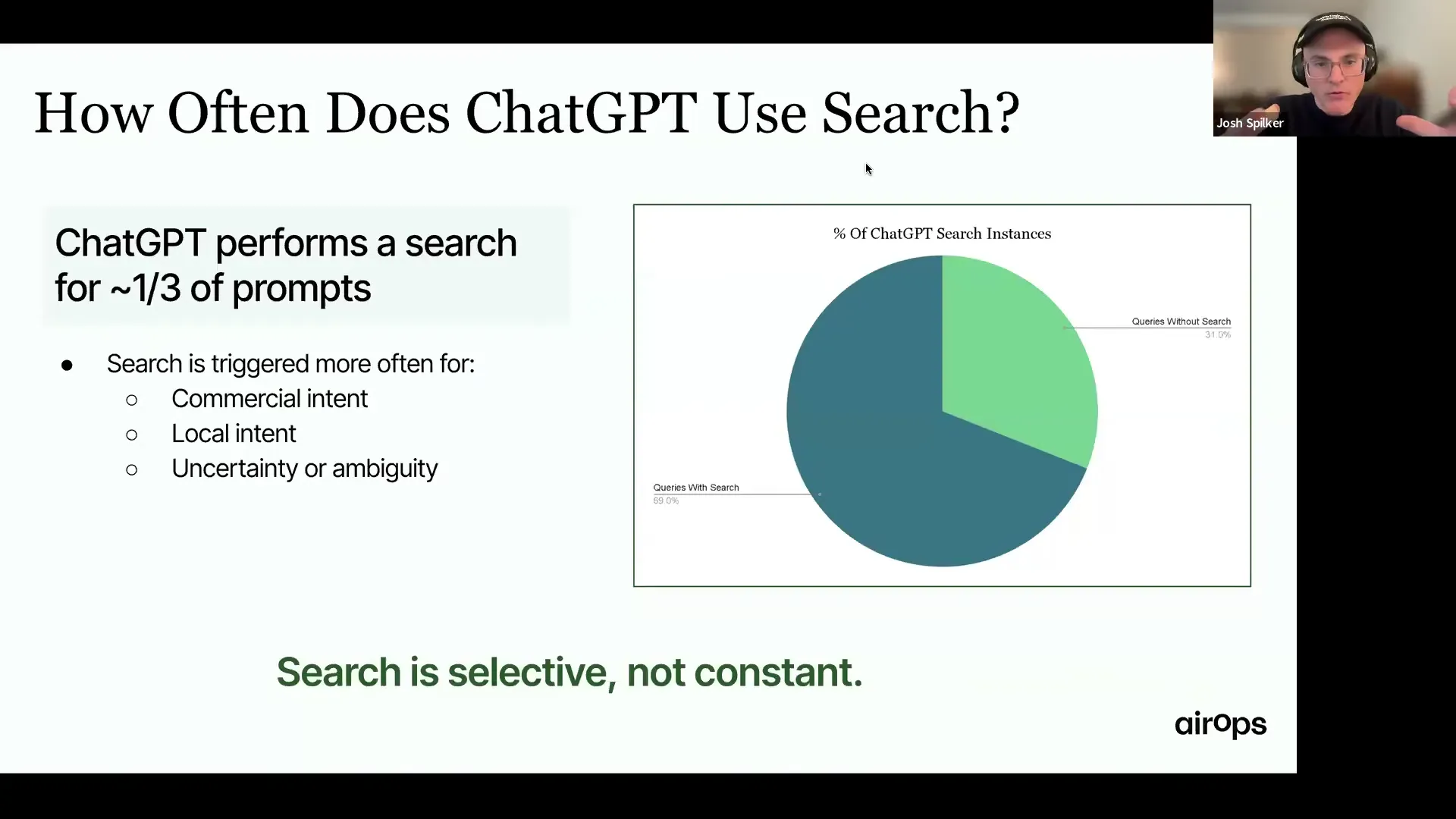
Nectiv's analysis, presented in an AirOps webinar, put concrete platform numbers on it: ChatGPT averages about two fan-out queries per prompt, while Google's Gemini averages nine. You can watch Chris Long walk through the full dataset here.
The practical takeaway is a tracking problem. If you monitor 100 keywords the old way, fan-out inflates that to somewhere between 600 and 1,000 underlying queries.
If you're tracking 100 different queries, you might have to track 600 to 1,000 to account for all the possible variations of what fan-out does to that individual prompt.
Here's how the two major platforms compare:
| Dimension | ChatGPT | Google AI Mode (Gemini) |
|---|---|---|
| Average sub-queries per prompt | ~2 | ~9 (5-11 typical) |
| Maximum observed | 3-4 | 27-28 (420 in Deep Research) |
| Average query length | ~5.5 words | ~9.1 words |
| Top pattern | Reviews | Freshness (current year) |
| Freshness window | Current year only | Current + previous year |
Why Don't Fan-Out Queries Show Up in Keyword Tools?
Because they aren't queries humans type. This is the single most disorienting fact about fan-out for anyone trained on traditional SEO. 85sixty found that "95% of fan-out phrases show zero monthly search volume, yet they are the gatekeepers of generative visibility." Nectiv's testing independently reached the same 95% figure. Your rank tracker literally can't see the queries that decide whether AI mentions you.
Length is part of why. The same 85sixty analysis clocked "average fan-out query length: 5.5 words (ChatGPT) and 9.1 words (Gemini) vs. ~3.4 for classic Google searches." Independent clickstream data from aeovision found "the average AI Mode query was 7.22 words versus 4.0 words for traditional Google search." Fan-out lives deep in the long tail, where keyword tools report nothing.
So the workflow changes. You can't research these queries in Ahrefs or SEMrush the way you'd research head terms. You have to extract your own fan-out set, which is where a web search API or the Gemini API comes in for pulling the sub-queries at scale.
What Patterns Dominate Fan-Out Queries?
Three patterns show up again and again: reviews, comparisons, and freshness. When Nectiv analyzed the most common n-grams across every fan-out query, "reviews" was the top term for ChatGPT by a wide margin, followed by the current year, then features and comparisons.
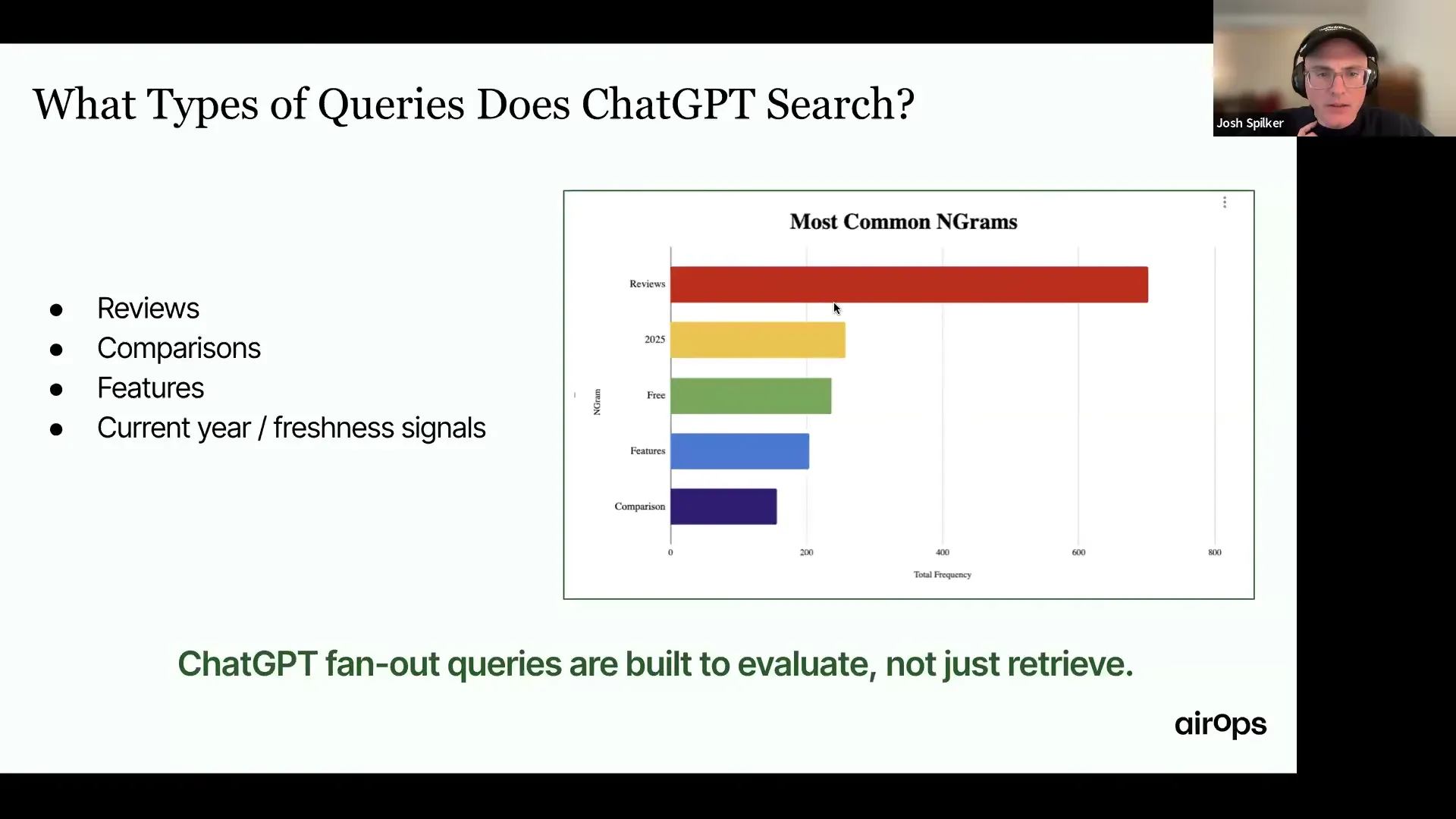
The point of those patterns is evaluation, not lookup. Fan-out queries are built to compare and validate, which is why review presence matters so much.
Reviews was by far the most common n-gram. If you don't have a dedicated reviews page and good reviews, and that search result shows up, you're at risk for not being recommended in AI chat.
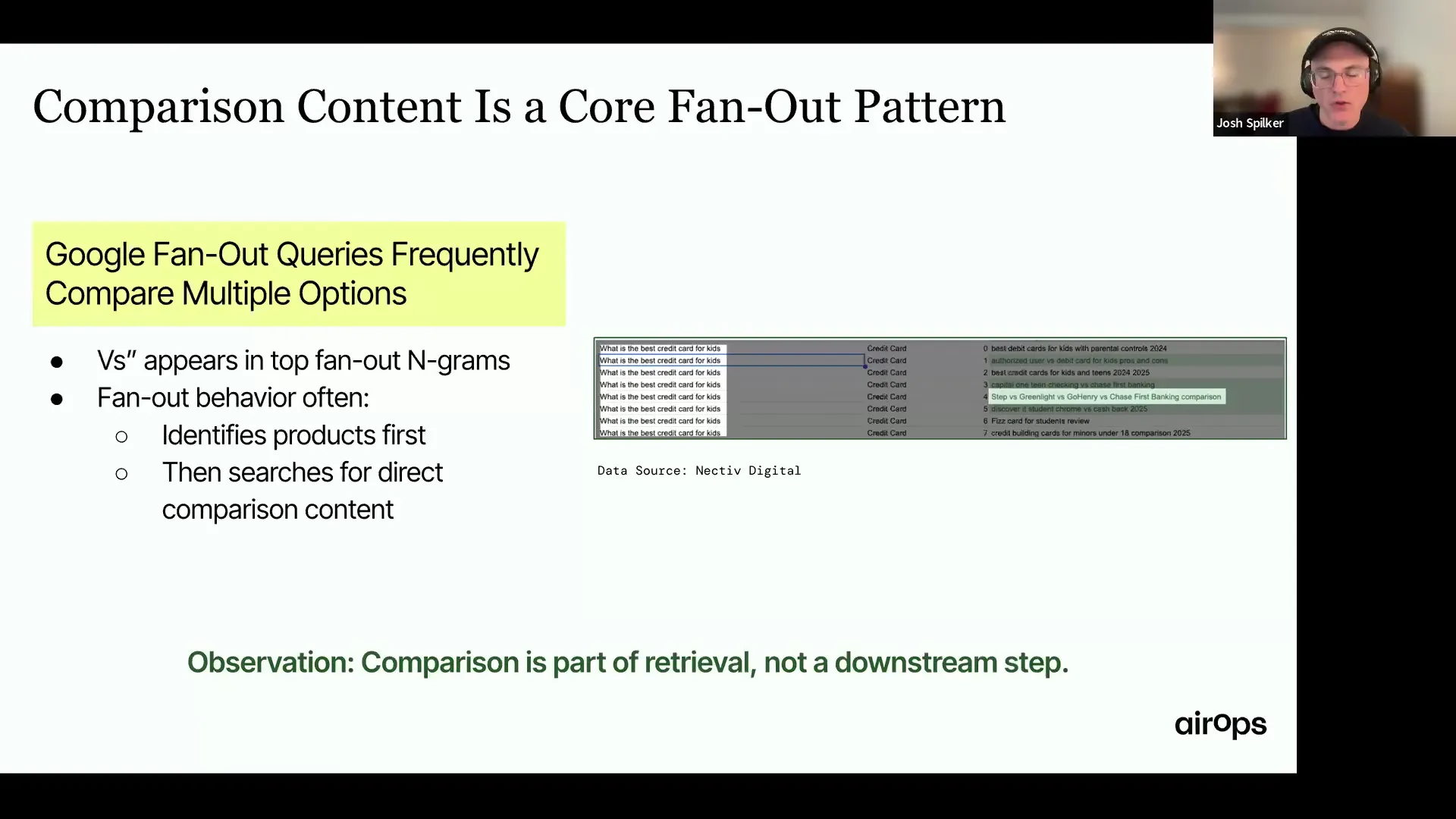
Comparison behaves differently than most SEOs expect. It isn't a downstream step after the AI picks a winner. It's part of retrieval itself. Google's fan-out starts non-branded, then self-selects a shortlist and searches the brands against each other directly. A prompt like "best credit card for kids" fans out from "best debit cards for kids with parental controls" into "Step vs Greenlight vs GoHenry vs Chase First Banking comparison."
Freshness is the third pattern, and the two platforms treat it differently. ChatGPT searches only the current year. Google searches the current and previous year, giving last year's content a grace period before it reads as stale. Google also rolls the calendar over slowly: when Nectiv pulled data in early 2026, "2026" made up only 3% of year-tagged queries, with 2025 still dominating.
Query Fan-Out by Industry: Where Does It Go Deepest?
Fan-out depth tracks buying complexity. The more involved the decision, the more the AI searches. Nectiv's industry breakdown for Google showed software prompts spawning 11.7 fan-outs on average, travel 10.8, careers 9.8, and local a comparatively shallow 3.79.
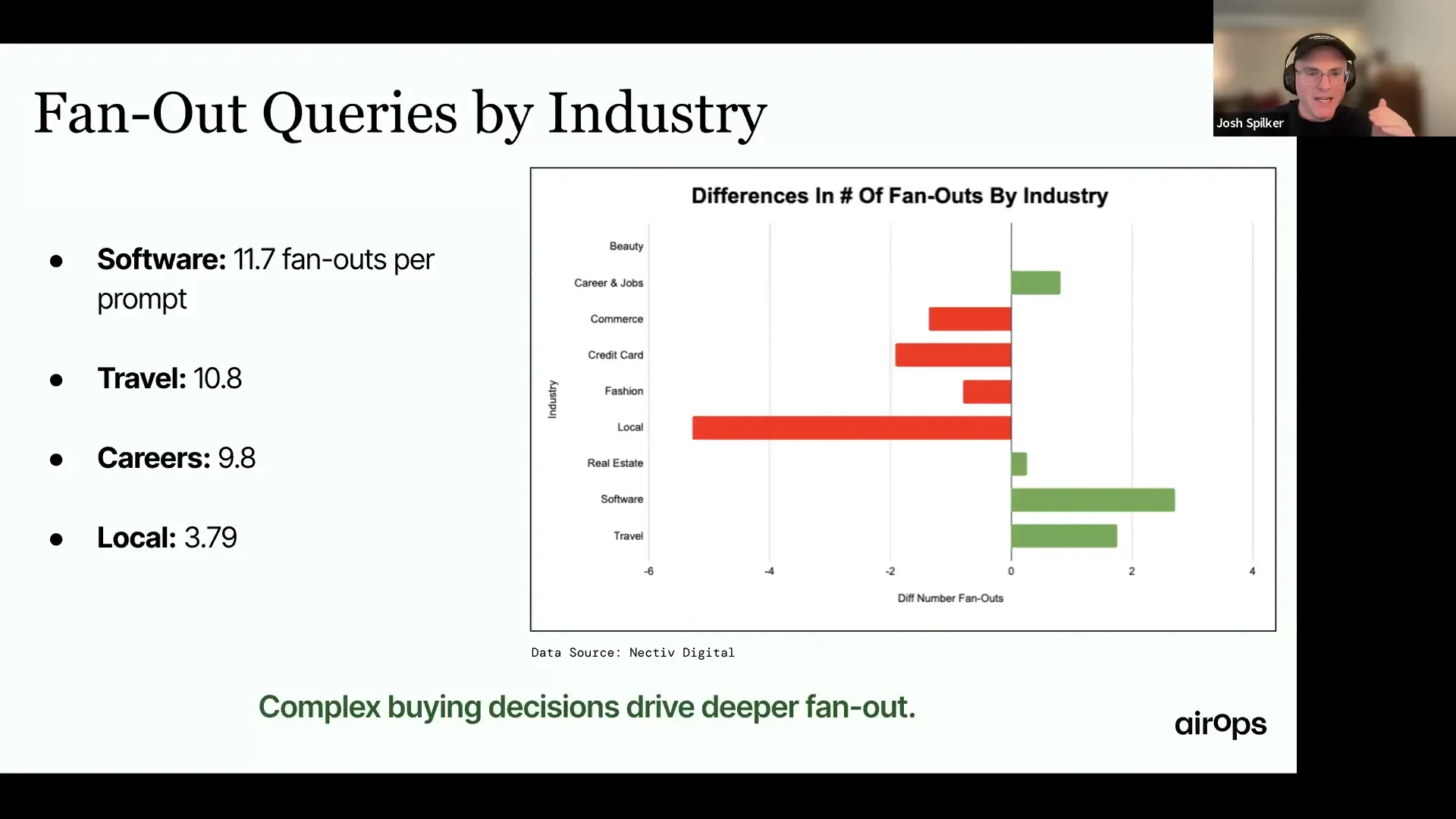
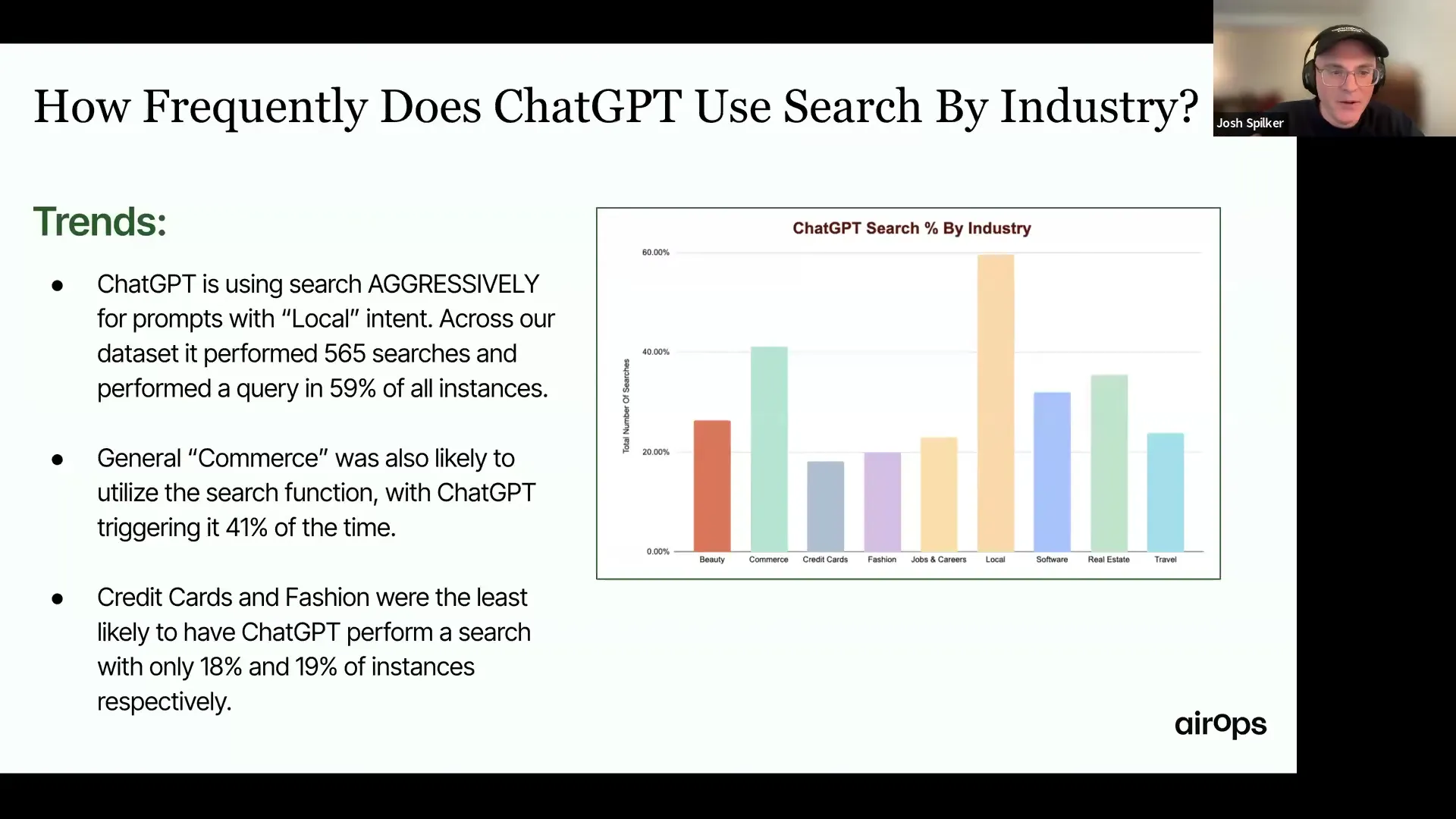
ChatGPT shows the same shape in where it decides to search at all. It ran a web search for local intent 59% of the time and for commerce 41%, but for credit cards only 18%. Search fires hardest on prompts that need real-time comparison, pricing, or reviews, and stays quiet on things the model already knows.
The lesson isn't to chase a single benchmark. It's to know your own category. A local business planning around nine fan-outs is over-preparing; a software brand planning around two is badly under-preparing. Google's own product team has described this expansion publicly, which our breakdown of Google's VP of Search on AI Mode and query fan-out covers in detail.
Why Does Query Fan-Out Matter for AI Visibility?
Because the click is disappearing and citation is replacing it. linksurge reports that "93% of AI Mode searches end without a single click." If the answer happens inside the AI, being cited in that answer is the whole game, and fan-out decides who gets cited.
The data says coverage of fan-out queries is what earns those citations:
- Ranking for fan-outs strongly predicts citation. A Surfer SEO study of 400,000+ searches found "you're 161% more likely to get cited in Google's AI Overviews if you also rank for fan-outs," and linksurge measured "a 0.77 correlation between fan-out query rankings and AI citation probability."
- Traditional rankings alone don't guarantee it. A December 2025 Surfer study of 173,902 URLs found 68% of pages cited in AI Overviews were not in the top 10 organic results. Coverage beats position.
- Structure earns citations. Per linksurge, "pages with FAQ schema are 60% more likely to appear in AI-generated answers," and "E-E-A-T signals show up in 96% of AI Overview citations."
- Most brands are invisible to it. The same ekamoira research found "88% of brands miss AI citations" because they optimize for head terms, not fan-out coverage.
Put together, these numbers explain the strategic urgency. This shift is part of a broader move in how people reach content, which our search engine referral report tracks across AI platforms.
How Do You Optimize Content for Query Fan-Out?
Treat it as a coverage problem, not a keyword problem. The goal is to be retrievable across the whole cluster of sub-queries your topic generates. Here's the practical sequence.
- Extract your fan-out queries. Use the Gemini API (the same one behind AI Mode), a data provider, or browser extensions to pull the sub-queries your key prompts generate. If you code, point a script or the Gemini 3 API at a prompt list and collect the fan-outs.
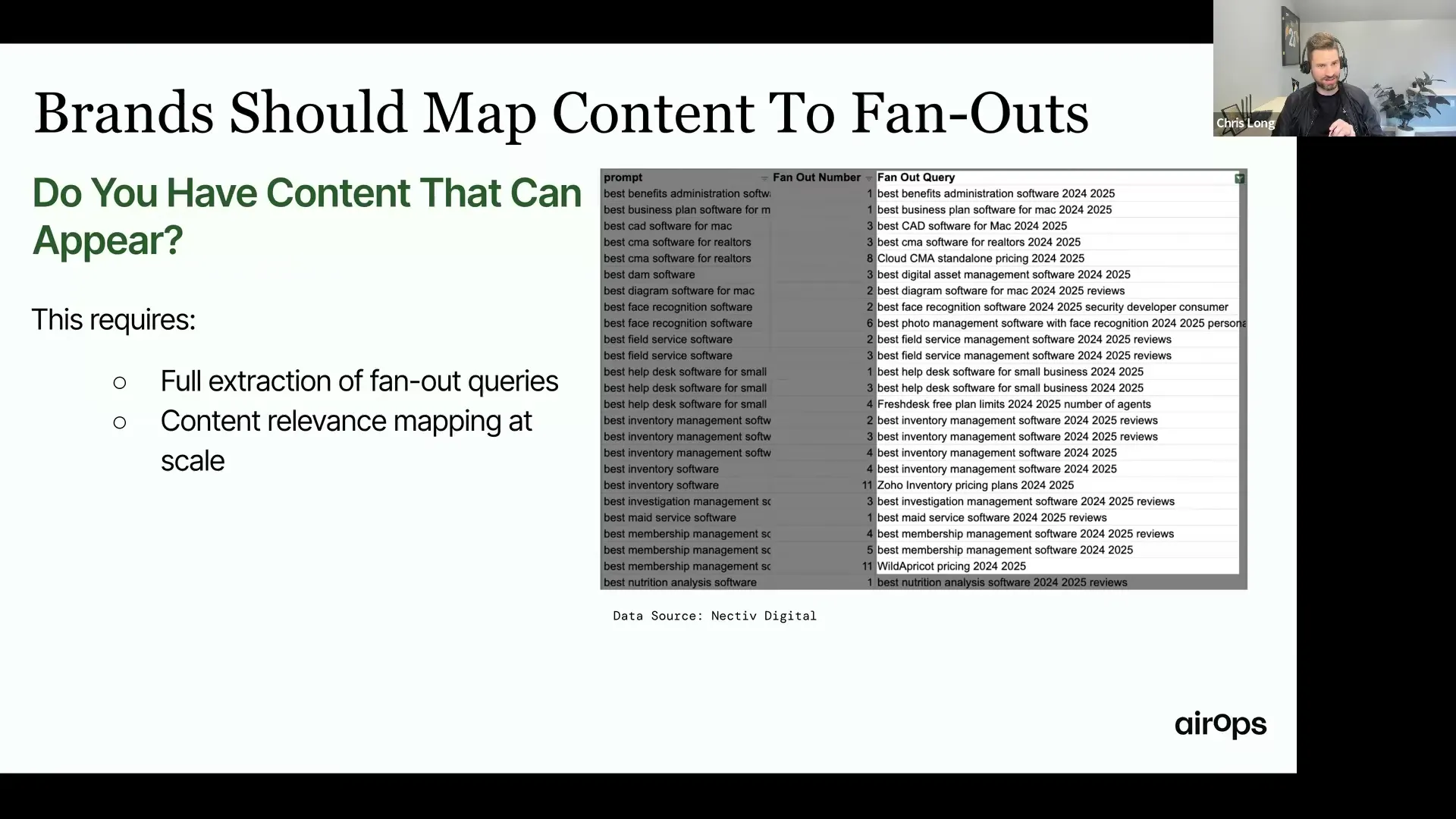
- Map fan-outs to your content. Run it like an old-fashioned gap analysis: for each fan-out query, check whether you have a relevant, well-optimized page. Most fan-outs map to content you already own.
- Own your comparison pages. Since AI searches "you vs competitor" directly, publish honest comparison content yourself instead of ceding it to third-party directories.
- Strengthen third-party reviews. Reviews are the top pattern. Your presence and ratings on platforms like G2, Capterra, and GetApp feed straight into AI answers.
- Add FAQ blocks and tables to commercial pages. Dense, structured passages are what AI extracts. Standalone FAQ pages underperform; FAQ sections added to pages you already want cited perform far better.
- Keep freshness current. Update commercial pages to the current year, but don't panic about year-old content on Google, which still reads the previous year.
For measurement, Chris Long's advice is to fold fan-outs into your existing reporting rather than build a parallel system.
Take your fan-out queries and create a segment for them in your rank tracker. That way you can either include them in your core KPIs or exclude them, and see across a thousand different fan-out queries whether you're trending up.
Common Query Fan-Out Mistakes to Avoid
Most fan-out failures come from applying old habits to a new mechanism:
- Chasing fan-out phrases as if they were keywords. They have zero search volume by design. Use them to guide topical coverage, not as literal title tags on thin pages.
- Ignoring third-party reviews. If your G2 or Capterra profile is weak, AI reads that weakness into its answer regardless of how good your own site is.
- Building standalone FAQ pages. The FAQ format helps because it's dense and extractable, but isolated FAQ pages tend to underperform. Add the blocks to pages that already carry commercial intent.
- Treating freshness as one-and-done. A single "2025" in a title isn't enough. On-page content and updates signal freshness, and the target year rolls forward.
- Tracking only head terms. If your reporting stops at the prompts humans type, you're blind to the 95% of fan-out queries that actually decide citation.
Frequently Asked Questions
What does query fan-out mean?
Query fan-out means an AI search system takes one prompt and runs several related sub-queries in parallel instead of a single search, then combines the results into one answer. SEMrush defines it as a process that "splits a user query into multiple sub-queries to deliver a better response." It's the core retrieval behavior behind Google's AI Mode, ChatGPT search, and Perplexity.
How many searches does query fan-out trigger per prompt?
It varies by platform. Google's AI Mode typically runs 5 to 11 sub-queries and averages around nine, according to both Ahrefs and Nectiv's analysis. ChatGPT is lighter, averaging about two. Complex prompts push higher: Google I/O 2025 data shows 12-15 sub-queries on average, and Ahrefs recorded ChatGPT Deep Research generating 420 in one extreme case.
What is the difference between ChatGPT and Gemini query fan-out?
Scale and vocabulary. ChatGPT fans out lightly, averaging two sub-queries with reviews as the top pattern, and searches only the current year. Google's Gemini fans out about nine times, leads with freshness, uses "vs" for comparisons, and searches both the current and previous year. Because both lean on reviews, comparisons, and freshness, optimizing for one platform largely covers the other.
Why do fan-out queries have no search volume?
Because they're generated by the model, not typed by people. Research from 85sixty and Nectiv both found about 95% of fan-out phrases show zero monthly search volume. They average 5.5 to 9.1 words, sitting deep in the long tail where traditional keyword tools report nothing, so you have to extract them directly rather than research them in an SEO tool.
Is query fan-out the same as semantic SEO?
They're related but not identical. Semantic SEO is the practice of covering all the concepts and questions around a topic on a page. Query fan-out is the AI's runtime behavior of searching those concepts as separate queries. Semantic SEO is a strategy you apply; fan-out is a retrieval mechanism you optimize for. Strong topical coverage happens to serve both.
How do B2B brands optimize for query fan-out?
Extract the fan-out queries for their core prompts, map them against existing content to find gaps, and prioritize reviews, comparison pages, and current-year freshness. Nectiv's data shows B2B software triggers the deepest fan-out (11.7 queries per prompt on Google), so software brands especially need broad coverage across features, pricing, and competitor comparisons rather than a single product page.
Does query fan-out replace keyword research?
No, it extends it. Head-term keyword research still tells you what humans search and what pages to build. Fan-out analysis tells you the hidden sub-queries AI runs against those topics. The practical move, per Chris Long of Nectiv, is to keep both in one rank tracker as separate segments so you can measure traditional visibility and fan-out coverage side by side.
Key Takeaways
- Query fan-out is parallel retrieval. AI search decomposes one prompt into many sub-queries, retrieves for each, and synthesizes a single answer. Single-keyword optimization no longer matches how the systems work.
- Google fans out ~9x, ChatGPT ~2x. Plan coverage around your platform mix and your industry, where software can hit 11.7 fan-outs and local stays near 3-4.
- 95% of fan-out queries have zero search volume. Keyword tools can't see them. Extract your own fan-out set through the Gemini API or a web search API and map it to your content.
- Reviews, comparisons, and freshness dominate. Strengthen third-party reviews, own your comparison pages, and keep commercial pages current-year.
- Coverage predicts citation. You're 161% more likely to be cited in AI Overviews if you rank for fan-outs, yet 68% of cited pages aren't even in the top 10, and 88% of brands miss citations entirely.
- Citation is the new click. With 93% of AI Mode searches ending without a click, being retrievable across the full fan-out cluster is what keeps a brand visible.
Primary research in this article draws on Nectiv's analysis of 60,000+ fan-out queries, presented by Chris Long in an AirOps webinar, alongside independent studies from Ahrefs, Surfer SEO, iPullRank, 85sixty, Conductor, and SEMrush. Figures are cited inline with their sources.